
SERP Keyword Clustering: The Definitive Guide to Hard vs Soft Algorithms
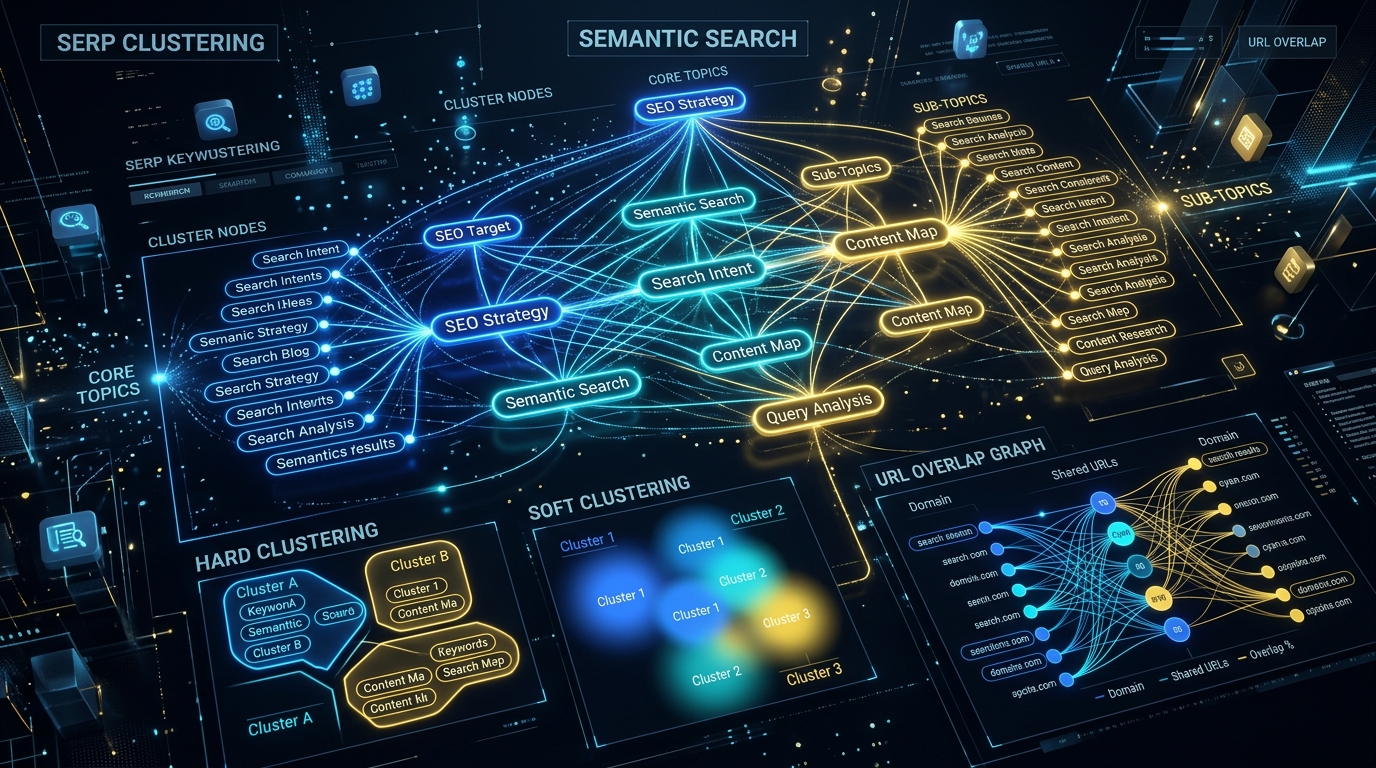
Table of Contents
- ›1. Why Manual and Morphological Keyword Grouping Fails Modern SEO
- ›2. Algorithmic Breakdown: Soft vs. Hard Clustering Methodologies
- ›3. Calibrating Overlap Thresholds (From 3 to 6 Intersecting URLs)
- ›4. Scaling 10,000+ Queries with AKRAMYS SERP Clusterizer
- ›Keyword Clustering Matrix: Manual Grouping vs. Professional SERP Automation
- ›Frequently Asked Questions about SERP Clustering (FAQ)
1. Why Manual and Morphological Keyword Grouping Fails Modern SEO
Categorizing keywords based purely on semantic intuition or shared root words inevitably causes severe Keyword Cannibalization. When multiple internal URLs target overlapping queries without distinct intent, search engines dilute ranking authority across all competing pages.
The SERP as the Single Source of Truth
The only reliable mathematical test of whether two search terms belong on the same landing page is real-time SERP URL overlap. If ranking competitors share multiple identical URLs in the top 10 for both queries, those terms can safely coexist on one target page.
- Linguistic similarity does not equal identical search intent in Google.
- SERP-based clustering completely eliminates self-cannibalization and diluted ranking signals.
2. Algorithmic Breakdown: Soft vs. Hard Clustering Methodologies
Modern clustering engines employ two distinct mathematical models for URL intersection evaluation:
Soft Clustering (Hub & Spoke)
Keywords are joined into a cluster if each term shares at least N overlapping URLs with the primary focus keyword. Subordinate terms are not required to overlap with one another.
Hard Clustering (Complete Graph Matrix)
Every keyword within the cluster must share at least N overlapping URLs with all other terms simultaneously, producing tightly focused commercial clusters.
- Soft clustering is optimal for informational hub pages and broad editorial guides.
- Hard clustering is essential for high-competition commercial e-commerce categories and product tiers.
3. Calibrating Overlap Thresholds (From 3 to 6 Intersecting URLs)
The overlap threshold determines the mathematical stringency required before terms merge into a single target URL.
3 URL Threshold (Broad Consolidation)
Builds extensive topic hubs. Ideal for newer sites building initial topical authority.
4-5 URL Threshold (Industry Gold Standard)
The optimal balance between intent precision and page consolidation for commercial websites.
6+ URL Threshold (Hyper-Narrow Segregation)
Generates dedicated landing pages for ultra-competitive transactional terms.
- Higher thresholds increase the total number of required landing pages.
- Thresholds below 3 risk merging incompatible search intents onto a single URL.
4. Scaling 10,000+ Queries with AKRAMYS SERP Clusterizer
Upload raw keyword datasets directly into AKRAMYS. Our cloud engine parses live multi-geo Google SERP data, builds the intersection matrix, and outputs structured Excel architecture ready for immediate copywriting execution.
- Parallelized processing of up to 10,000 queries without proxy or CAPTCHA friction.
- Automated primary keyword selection based on search volume and intent alignment.
Keyword Clustering Matrix: Manual Grouping vs. Professional SERP Automation
| Operation Aspect | Manual Guesswork Mistake | AKRAMYS Professional SERP Solution |
|---|---|---|
| Grouping Logic | Groups words by literal root ("buy laptop" and "laptop repair" onto one page). | Analyzes live TOP-10 URL overlap: if overlap is 0, creates dedicated landing pages. |
| Scalability | Spends weeks manually filtering 5,000 spreadsheet rows. | Processes multi-thousand datasets in 2-3 minutes in the AKRAMYS cloud. |
| Cannibalization Control | Creates multiple overlapping pages that cannibalize impressions and drop in rank. | Hard clustering with 4+ URL threshold creates monolithic, authoritative landing targets. |
| Content Brief Generation | Hands copywriters unorganized keyword lists without clear structural hierarchies. | Exports automated briefs with designated Title, H1, and LSI entities for every cluster. |
Frequently Asked Questions about SERP Clustering (FAQ)
Q:What should I do with unclustered (orphan) keywords?
If an orphan keyword has strong commercial volume, build a dedicated landing page. If volume is negligible and intent is vague, discard it.
Q:Does geographic location impact SERP clustering results?
Yes, significantly. Google SERPs differ between countries and languages. Always configure your exact target market in the clusterizer settings.
Q:When should I choose Soft vs Hard clustering?
Use Soft for informational content, guides, and news. Use Hard for commercial e-commerce, category pages, and service offerings.
Q:How often should a site re-cluster its keyword architecture?
Re-cluster every 6 to 12 months or following major Google Core Updates, as search intent and SERP structures evolve over time.
Recommended Reading in this Topic Cluster:
Cluster thousands of keywords with mathematical precision
Leverage the AKRAMYS SERP Clusterizer to build cannibalization-free site structures in minutes.